
Is Chris Pennie's "Polyrhythmic Potential" Useful?
Reviewing the former Dillinger drummer's instructional book

With 2025’s final considerations out of the way, welcome to 2026. Sure is off to a completely uneventful and in no way distressing start, am I right folks? Say, why don’t we take our minds off of the “not much” that’s happening and talk about drums for a bit?
As I mentioned in my list of the twenty-five best albums of our recently departed yesteryear, 2025 was my first full passage through the calendar as a professional drum teacher. I like my job. I can tell I like my job because I spend a lot of time thinking about how to get better at it. In that pursuit I pulled out my collection of drum education books and have been gradually working my way through them. I get better, I learn new exercises to offer my students, and when I finish the book I get to write about it for you. Win-win-win. Last year I wrote about Stick Control (GOAT’d, bring your own sauce) and Progressive Independence: Jazz (pretty good!). Today I’d like to continue this line of inquiry with Polyrhythmic Potential by Chris Pennie.
Pennie, if you are unfamiliar, made his name as the original drummer for The Dillinger Escape Plan, a hardcore punk band that set a new standard for outrageous technicality in the genre in the late 90s and early 00s. After recording on Calculating Infinity (1999) and Miss Machine (2004), Pennie abruptly quit the band in 2007 to join Coheed & Cambria, a much more successful pop rock act with prog-dork aspirations. Pennie recorded one full length album with Coheed, 2010’s Year of the Black Rainbow, and then promptly quit to play in acts too obscure for a general audience to know anything about.
In 2008 Pennie, collaborating with fellow drummer Joe Bergamini, published Polyrhythmic Potential: Creating A Polyrthmic Vocabulary. The book features transcriptions of five songs from Miss Machine, as well as a sequence of exercises relating to the application of several common polyrhythms, plus a short interview with Pennie, and a list of album recommendations, AND a CD with a bunch of mp3s on it. By that description you’d expect Polyrhythmic Potential to be thick enough to throw in front of a kick drum. Instead Pennie and Bergamini cram all of that content into just under 70 pages. The transcriptions take up about a third of the book, the exercises a little less than that, with the final third given over to extras and practical inclusions (notation keys, table of contents etc). This divided structure raises a question about the purpose of the book. Is Polyrhythmic Potential a guide for drummers looking to develop their understanding of polyrhythms or is it the first step for drummers embarking on the daunting task of learning how to play multiple Dillinger Escape Plan songs note-for-note? In short, is the book better described by its title or by its author?
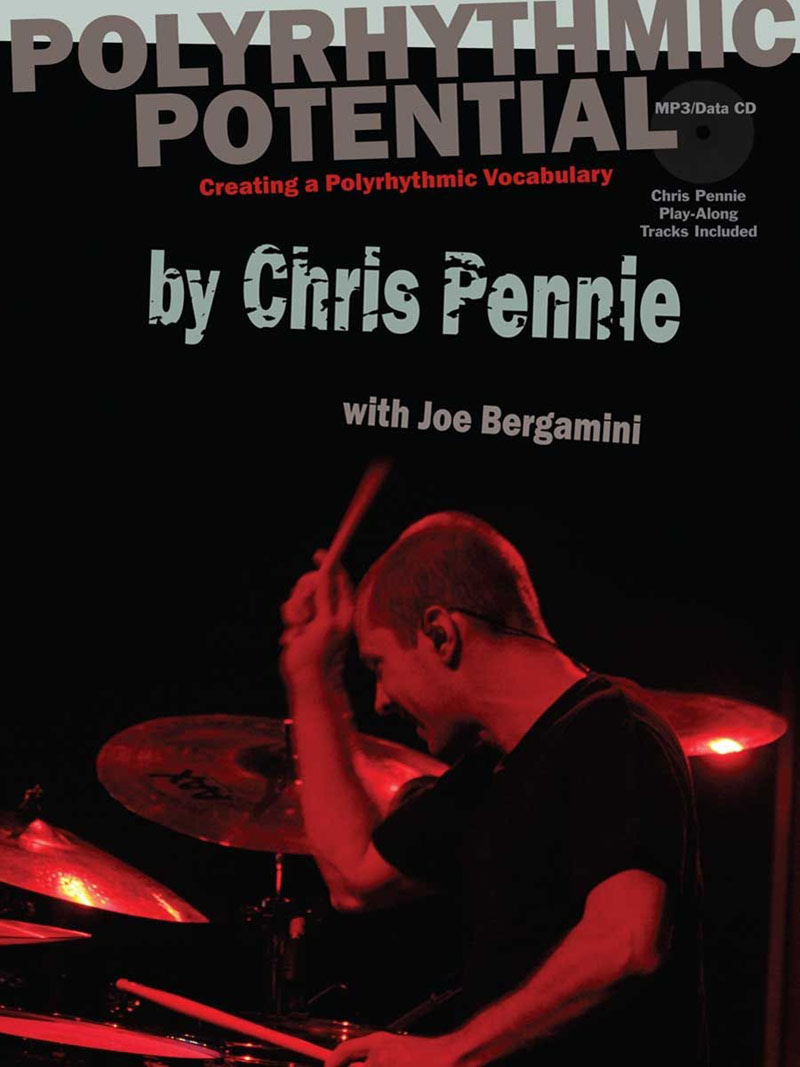
A good rejoinder to that question might be “why not both?”. Certainly the Venn diagram of drummers with an interest in learning Dillinger songs who also might want to brush up on their polyrhythms is closer to a circle than any other known shape. In this light, Potential is a smart piece of marketing. However, there are vastly more drummers for whom an interest in polyrhythms does not necessitate an interest in hyper-aggressive hardcore punk. These drummers will have no use for the second half of Potential and are likely to find the first half too slight. Pennie & Bergamini offer some useful tools in the book’s first section. It’s always nice to have a reference on hand in case you forget how to write out a 7 against 4 pattern, for example. In each chapter, these common patterns get filtered through a number of different arrangements. You’ll be tasked to play the polyrhythms against static sticking patterns or to play them across several different limbs. Some of these exercises are exceedingly difficult. In Pennie’s hands something as simple as a paradiddle turns into a medieval torture device.
A drum book is not judged simply by the difficulty of the material it contains. For an educator even these brain-busters feel insufficient. Pennie & Bergamini spend about as much page real estate writing about their concepts as they do demonstrating them in exercises. That might seem helpful in theory, but in practice these text portions only serve to slow the student down. I’ve mentioned before that drum books share a number of qualities with video games. Any gamer knows that it flat out sucks to be pulled out of the action just so a character can talk to you at length about some shit you don’t care about. No one likes lengthy tutorials or unskippable cutscenes. You don’t need to explain the game to me if you just let me play it. Potential’s text intrusions take space away from iterations of the exercises that could help smooth the difficulty curve between their basic forms and the insane double kick variations Pennie gives you by the end. Just look at any of the great drum books, your Stick Controls and New Breeds, and you’ll find far more pages of drum notation than pages of written English. Asking the reader to do the work of coming up with their own patterns or reading further in other books just begs the question of why we should be reading this book to begin with.
To Pennie & Bergamini’s credit, they acknowledge that the first half is meant to be a supplement to the transcriptions in the second half. Problem is, they don’t do much work to show how the exercises apply to the songs on the backend. If the purpose was to elucidate the concepts behind Dillinger’s songs, why not put the tunes front and center? Why not give each of them their own chapter with detailed explanations of how to approach certain trouble spots instead of offering only a blurb on them at the front? In other words, why not make something closer to Mike Portnoy’s educational DVDs? Portnoy is no great educator, but he is an enthusiastic and charismatic advocate for his work. The video format lets him sit at the kit and break down his parts with a high level of detail. He isolates specific patterns, plays certain sections slower, and talks at length about his approach to song & part writing. I would love to watch Pennie talk through “Panasonic Youth”, but I suspect that the audience for a DVD about The Dillinger Escape Plan drum parts isn’t large enough to move the kind of units an equivalent DVD about Dream Theater commands. So instead Polyrhythmic Potential has to play to two audiences at once and ends up satisfying neither.
~ ~ ~ ~ ~ Listening Diary ~ ~ ~ ~ ~
Listen to this year’s diary on Apple Music.
“Crime Wife” by Gláss (S/T, 2025)
For the first few weeks of the year the Listening Diary is going to look like the Honorable Mentions for my 2025 list. I heard about this record from a post by Doug Moore (Pyrrhon et al) who marked as an early EOY contender. S/T has a real intimidating run time, so it took me a while to take him up on his recommendation. On first blush you might mistake this group for Brits, they might remind you of DITZ for example, but in truth North Carolina is a sneaky powerhouse of state-side post-punk. ~*My Fiancée*~ keeps joking that we need to commit more crimes together, inspired by too much Better Call Saul, I think. I guess I’ll have to consider this for our wedding playlist lmao.
“XYZ” by Hiromi (Out There, 2025)
Absolute shred-jazz madness. Other than the squeeky clean production and the choice of gear (thinner ride cymbals, actual acoustic pianos) there is nothing separating this from progressive rock.
“Postparto” by Hesse Kassel (La Brea, 2025)
There are windmills whirring all over the globe. Hesse Kassel hail all the way from Chile, but it sounds like they’ve kept an ear out for the developments in rock technology currently underway up north in the UK. Fans of the early Black Country, New Roads material will spot the formula here: talky drawn out post-rock, but with the obligatory LOUD section tearing away into odd time signatures and dissonant guitar riffs. Had I heard La Brea sooner and were its length less of an impediment to frequent rotations, I bet this record would have made it onto the list proper.
“Out of Dust” by Djrum (Under Tangled Silence, 2025)
The piano melody on this tune reminds me a lot of the stuff Benn Jordan wrote on Soundtrack to A Vacant Life, but Djrum makes way better use of that space than anything in the Flashbulb discography. Not to be shady, I’m just saying this track sounds GREAT.
“The Last Ones of Our Kind” by Paatos (Ligament, 2025)
I love that their bandcamp account includes “Sweden”. Like we couldn’t tell. Paatos aren’t the first and likely won’t be the last progressive rock group to emerge from Scandinavia with a fleet of keyboards and a melancholic disposition.