
What's The Deal With Blast Beats?
A look into the form and function of an extreme music staple

A few years ago while working on The Lonely Atom, my co-producer Jack Greenleaf swiveled his office chair around with a quizzical look on his face and asked me “What’s the deal with blast beats?”. Jack is neither a metal guy or a drummer, so this line of questioning did not surprise me. I also understood that Jack wasn’t asking a question about what blast beats are on a practical level or how to perform them. Instead he was asking about their purpose. Why do drummers choose to blast when they do? What do they mean, musically speaking?
Jack is not alone in his curiosity about blasting, a drum technique ubiquitous to multiple strains of heavy music. As a teen who spent his free time after school bouncing between several forums dedicated to drumming and/or heavy metal, threads about blast beats were dime a dozen. Young drummers asked how to get better at playing them. Speed freaks demanded that you post your favorites. Older fans complained about their prevalence, especially if they were quantized in ProTools or played with triggers. Forums may be dead, but blasts remain an object of fascination. One of my favorite Instagram accounts calculates how long drummers spend blasting and rate their albums accordingly. In the last decade blast beats have started cropping up on indie rock records, thanks in part to its mutual flirtation with black metal in the first Obama term. Let me put this another way. How many other drum beats in rock music do you even know by name?
For all the fuss made about them blast beats are simple enough that you could get a first time drum student playing them (slowly, badly) in under half an hour. To play a blast beat you hit one cymbal with your right hand while you hit the kick drum with your right foot, then you hit the snare drum with your left hand. You do those two steps as fast as you can for as long as you can and tada, you’re blastin’. Here, why don’t we let Derek Roddy, whose forum was an indispensable resource for extreme metal drumming tips in the 00s, explain it for me:
As Roddy alludes to in this clip, the simplicity of the blast beat allowed drummers to iterate endlessly. What started as punks trying to play as fast as they could with no regard to meter or tempo has gradually become a cross between drumline and sports science. As drummers attempted to one-up each other blasts got faster, more precise, and lasted for longer. To match these increasing demands, extreme metal drummers adjusted every element of their playing (their hand technique, their feet, the tuning of their drums, the height and layout of their kit) to blast with maximum efficiency and to maximum effect. Just look at how Spencer Prewett of Archspire breaks down his approach to the technique:
None of this answers Jack’s principle question, however. What is all of this athletic efficiency in service of? No matter whether you play traditional blasts or bomb blasts, flat foot, swivel or heel toe, blast beats have a singular musical function. Whether by outlining every subdivision available in the meter or by ignoring meter entirely blast beats cede the domain of rhythm to the rest of the band. Typically drummers define a song’s rhythm by choosing which beats in the meter to emphasize and which to leave silent. Blast beats leave no note unplayed and all with roughly identical emphasis. Some drummers get around this by accenting other cymbals with their lead hand, but as long as the kick and snare chug along underneath these melodic flourishes can only do so much. Instead it is up to the strings and vocals to guide the pace of the music.
Why would any drummer choose to do this? The honest and simple answer is that blast beats sound bad ass and feel great to play once you’re good at them (before that they are torture). Even setting aside the adrenaline rush of going HAM, blast beats are indispensable as an arrangement tool. Because they line up with the entire available grid, blast beats could conceivably go with anything. Not only that, but they can also lead out of or into any other rhythm. Blasting is almost like shaking the meter’s Etch-A-Sketch, a way of resetting the clave. Blast beats seem to work for any part of a song. They are a great bridge from one groove to another. They build tension and they release it.
Beyond their utility, blast beats offer a number of expressive possibilities. Again, they are about as extreme as it gets. If you really want to blow someone’s lid, hit ‘em with some blasts. A good drummer will make blast beats feel like stepping into a wind tunnel. They have the force of a natural element. A raging inferno, a furious current, the unrestrained speed of a storm. However, blast beats can just as easily evoke the mechanical as the organic, in part because machines are very good at playing them. Blast beats can also be the factory, the artillery fire, the whirr of industrial blades, the grinding of gears. Their sheer intensity also gives them a Romantic quality. They are a limit experience and can stand in for the overflow of just about any emotion. For all of the metaphors of anger that I’ve used in this letter, blasting works just as well for everything from the sublime, to the ecstatic, and the truly despairing (if you know, you know). In my own work, including the song that Jack was likely working on when he spun his chair toward me, blast beats have almost always stood in for erotic tension.
But really, I could have just told him that they sound gnarly and left it at that.
# # # # # The Promo Zone # # # # #
Ferrn will perform at the Cobra Lounge on Saturday, February 28th along with our homies Soft Fiction, and new friend Jack Riedy. We’ve been practicing hard to get some new material ready for the show, and we’ll be joined by the Hydrosonic Light Show, who are providing unique analog/digital visual projections during the whole concert. Bro, I cannot wait to play this god damn show. Grab your tickets here!
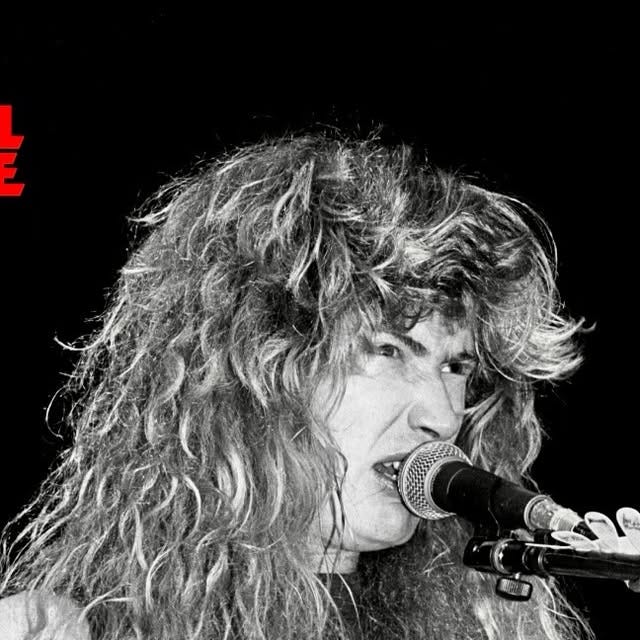
The editors at the newly rebooted METAL EDGE asked me to rank all 17 Megadeth studio recording album in ascending order from worst to best for the Instagram page, in time for the announcement of the band’s latest tour. A dedicated subscriber of this very newsletter had forwarded my Micro Reviews to Metal Edge and they liked them enough to give me free reign on both the order and the copy. This was an insane and brilliant idea. Not only do I have great taste in metal, I also have unconventional opinions about Dave Mustaine’s discography. In other words, engagement gold. I had a blast putting this list together, and almost as much fun watching people get HEATED about some of my choices.
~ ~ ~ ~ ~ Listening Diary ~ ~ ~ ~ ~
Listen to this year’s diary on Apple Music.
“Trial” by Eiko Ishibashi (Antigone, 2025)
Shameful confession, I haven’t seen Drive My Car or any of the Hamaguchi films that Eiko Ishibashi has scored. Instead I came to this raw on the strength of good reviews and a dope cover. Didn’t expect things to get so prog-y, but you know I’m with it!
“Flight Risk” by PremRock (Did You Enjoy Your Time Here…?, 2025)
Some inspired production here, especially in the second half after the beat switches up. Sounds to me like a blend of bird calls and dial up sounds. Hard to tell, which is in itself pretty damn interesting.
“Tiramisu” by Gelli Haha (Switcheroo, 2025)
Of all this songs on Swircheroo, this one sounds the most like the album cover. Bright, colorful, high energy, but also so eager to be fun that it’s cracking up at the seems. I love the way the vocals teeter on the edge of going completely out of tune. That bratty tone is perfect for the song.
“Can’t Stop Me” by Homeboy Sandman (Soli Deo Gloria, 2025)
Let me get my negativity out of the way first. Yes, this AI art sucks, especially coming from an artist who clearly holds craft and independent artistry in such high regard. I will eventually go long on my issue with AI in music, but not right now. What I’d like to talk about is #bars!! Even though Homeboy Sandman compares himself to Rudy “The Stifle Tower” Gobert, he reminds me way more of Kyle “Slo-Mo” Anderson. Anderson, true to his nickname, plays so much slower than his opponents expect that they end up overreacting to his moves and leave him wide up for a seemingly easy basket. Sandman does the same thing with his punchlines. He takes as much time as he needs no matter how small the word count of each bar is. Try and guess where he’ll end up and you’ll often overthink it before he delivers a “duh how did I not think of that” gem of condensed wisdom. Great rapper. Hire an album artist next time.
“Break The Tension” by Maruja (Pain to Power, 2025)
It is always a good idea to take edited live footage played over studio recordings as a grain of salt. With a big enough crowd and talented enough editor you can make any band look like they’re killing it. But, I mean, this lads sure do seem like they can set it off in person. Hard drums, dirty bass lines, and a saxophonist arpeggiating his way out of hell and into heaven. I should check to see if Maruja are ever coming stateside…
\ \ \ \ \ Micro Reviews / / / / /
Here are five micro reviews of albums from my vast Rate Your Music catalog. Long time Lamniformes Instagram followers will recognize these from my stories, however they’ve been re-edited and spruced up with links.

Hot Rats by Frank Zappa (1969) - Jazz Fusion
I am emphatically NOT a Frank Zappa guy, despite by appearances seeming like one (opinionated music school grad with a tendency towards obsession with idiosyncratic rock auteurs). I make an exception for Hot Rats because it features all of the stuff that I like about Zappa and none of the stuff that I don’t. In other words, no cartoon voices singing boomer-humor brain rot lyrics, but a whole lot of instrumental shredding. This is so far the only Zappa record I’ve listened to that gives me the impression that the guy actually likes music. I mean jeez, the opening and closing tracks are legit pretty! The record balances tightly composed tracks that show off Zappa’s unique arrangement philosophy (all sorts of strange instruments combos doubling phrases with gnarly nested rhythms) and tracks where the band just lets it rip on simple jazz rock vamps. There is wilder instrumental fusion out there, but this could fit right in with your Mahavishnu’s and Return to Forever discs if you got ‘em. If you ever need to pacify an annoying man with a ponytail, just tell them you’re cool with Hot Rats and they’ll leave you alone.
The Real Thing by Faith No More (1989) - Hard Rock
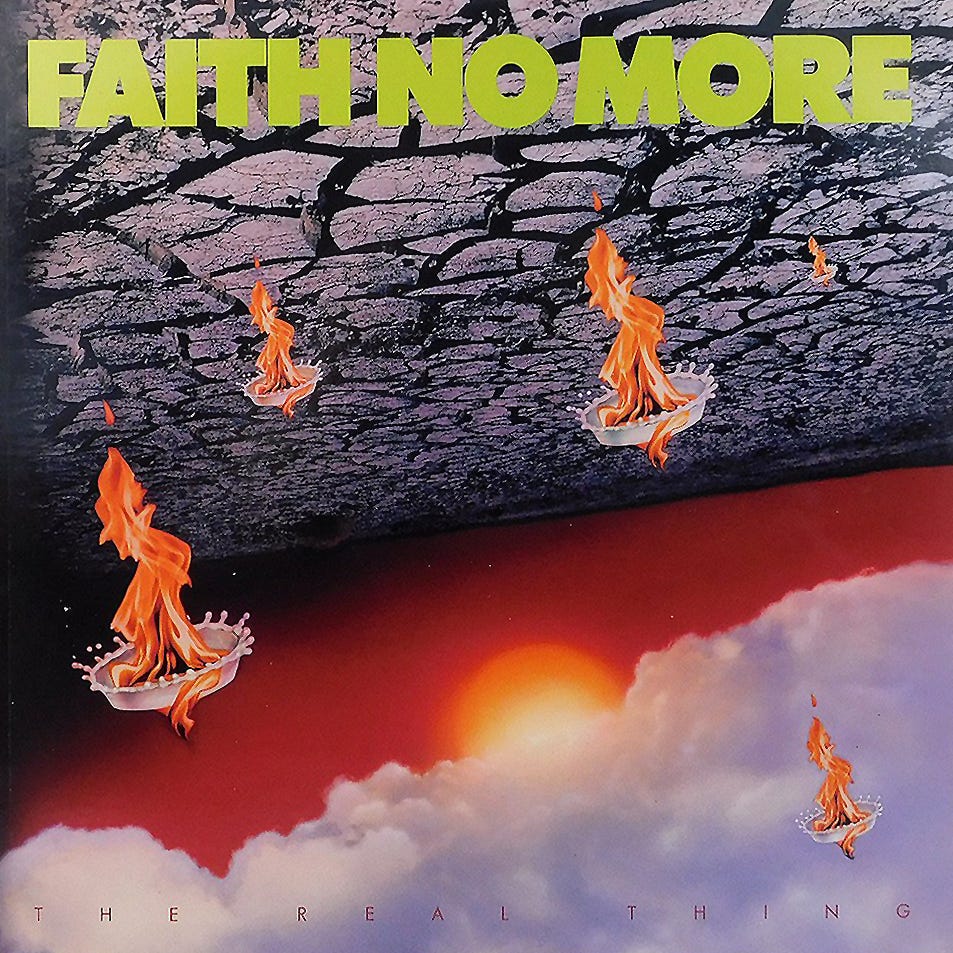
1989, a year between the peak of cornball hair metal and the grunge explosion, must have been an awfully strange time to be a major label rock band. Faith No More were just the band for such a moment. Everyone on The Real Thing seems to have a different idea about musical situation they’re in. Drums and bass are playing funk rock, the guitarist is playing thrash metal, and the keyboardist is giving a demo of consumer grade Yamaha equipment. Vocalist Mike Patton, in his career making debut, does not simplify matters. Even as a literal teenager Patton switches effortlessly (ymmv) between blue-eyed soul crooning and hardcore barking. For the first two thirds of the record this hodgepodge approach works some genuine magic. I would love to live in the world where nü-metal took more after the R&B + hard rock sound of “Falling To Pieces” than the rap rock of “Epic” (though that song is a blast on its own terms). When Faith No More do play the hard stuff straight like on “Surprise! You’re Dead!” they do so with gusto.
The Eye of Every Storm by Neurosis (2004) - Post-Metal
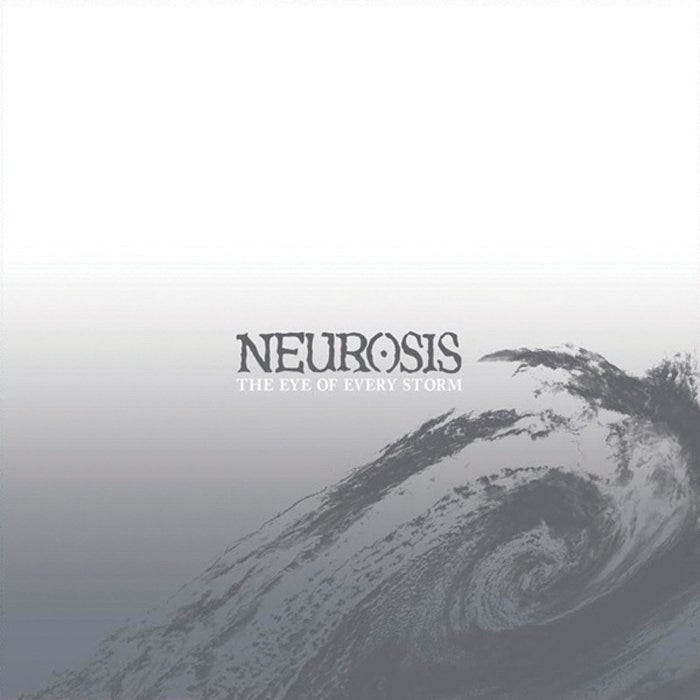
The soft Neurosis record, though it might be more accurate to call it the sparse record. Neurosis are just as brooding and dissonant as they’ve ever been, but on these tunes they strip back the distortion and shave away the layers. When they do crank the volume, they do so selectively. Instead the songs are defined by negative space. The harshest sounds usually happen at a distance, evoking the howling storms just outside the cave walls while a fire crackles nearby. Yes, this is some rugged man vs nature stuff, the kind of thing that seemed serious minded and deep when I was 19 and spent more time thinking about the idea of reading Cormac McCarthy than actually cracking open a book. These days it doesn’t do as much for me, though there are a lot of fascinating sonic choices, thanks to late Neurosis MVP Noah Landis. “Left To Wander” and “Bridges” are both legit cool tunes. Conveniently, Scott Kelly sounds awful on the three songs he sings lead on, so you aren’t missing much if you skip those for ethical reasons.
The Fathomless Mastery by Bloodbath (2008) - Death Metal
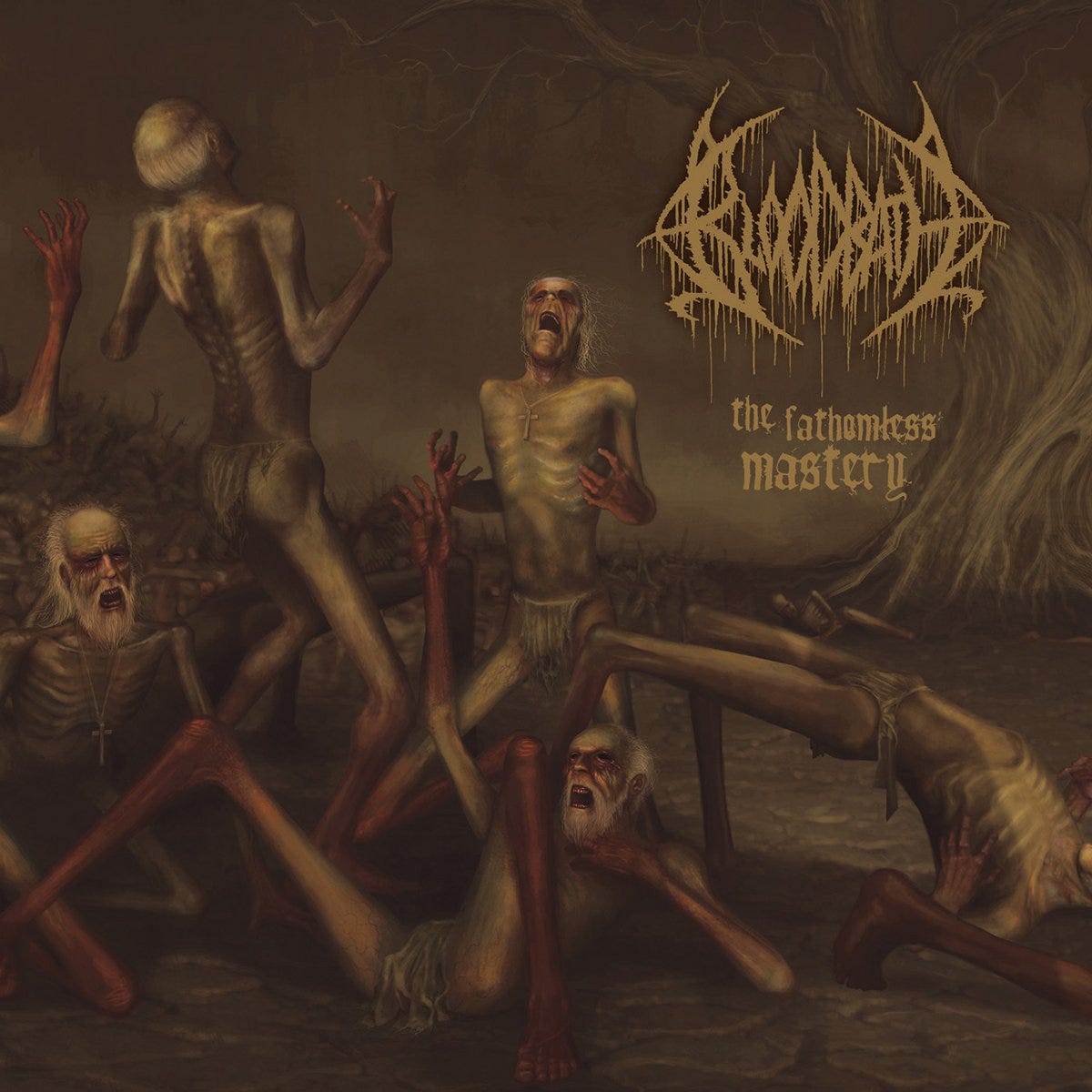
One of the best death metal albums of the Xbox 360 era. Mikael Akerfeldt returns to the Swedish supergroup to throw a farewell party for his harsh vocals before going full bell bottoms for the next decade. Though Bloodbath’s mission statement of playing tribute to the grimy early days of 90s Swedish death metal remains, Mastery is the first album where you can start to hear the members’ day jobs seeping in. Everything is crisper and tighter than on the previous records, and the songwriting incorporates more odd time signatures and fancy rhythms. Part of this crispness comes from new drummer Martin “Axe” Axenrot. The gear shift Axe pulls off at the start of “Treasonous” is a good example of his general nastiness on this record. If I had to pick nits, this could stand to be a bit shorter, but the quality of songwriting is so high across the board that there are no obvious cuts.
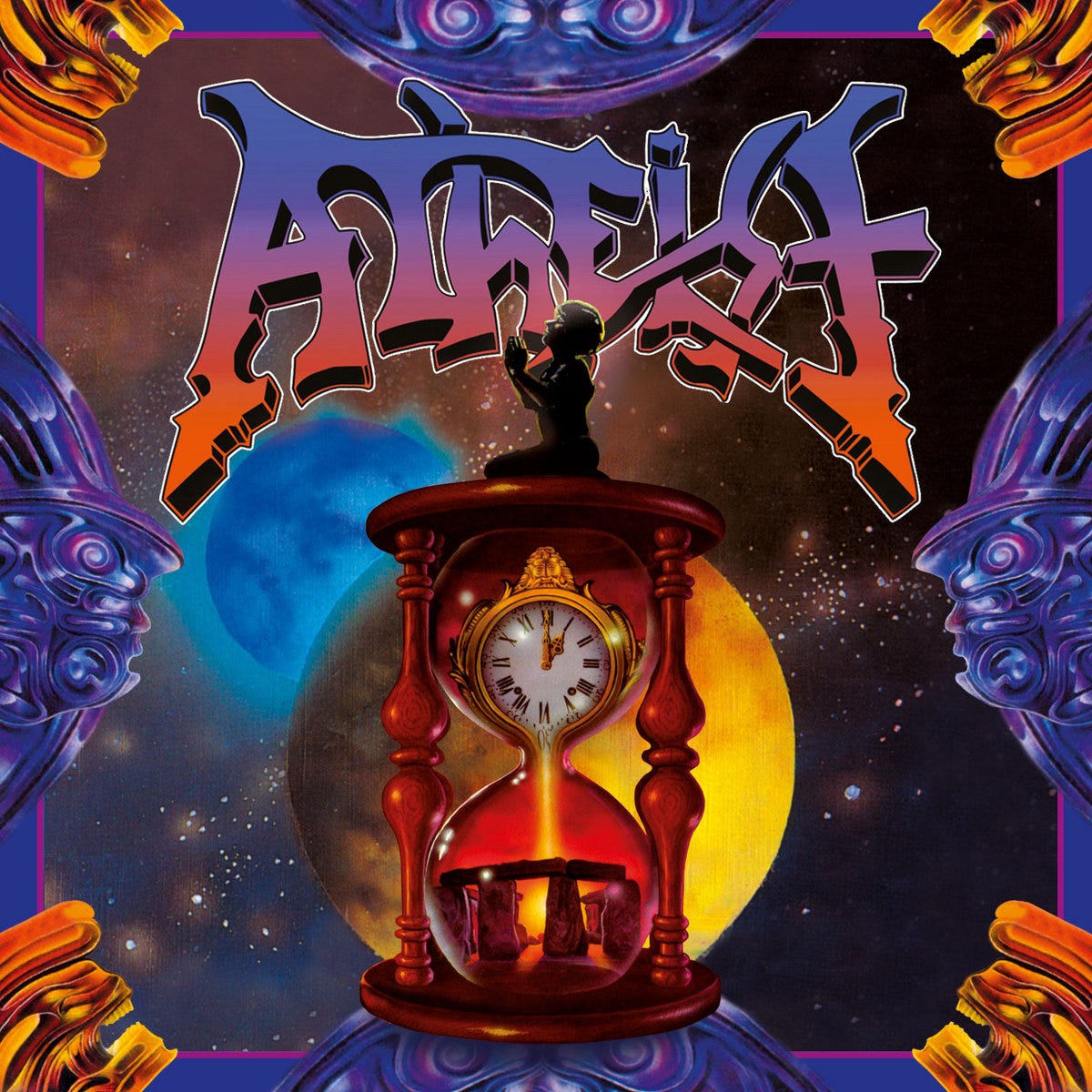
Unquestionable Presence: Live at Wacken by Atheist (2009) - Death Metal
I received this live album as a throw-in when I bought a handful of used CDs from an older metalhead around 2010. I knew from lurking on metal forums that Atheist were a cult favorite like Cynic who never got the shine they deserved in their early 90s heyday. I gave it a listen out of respect but didn’t connect with it. Also like Cynic, Atheist introduced a heavy dosage of jazz fusion into extreme metal’s bloodstream. The difference is that Atheist’s version of fusion is the big mullet-ed coked-out slap-bass-solo kind. They play with a maniac level of activity, as if stammering to get their words out before they finished thinking them. Returning to this disc now I can better appreciate how unique their style is, though it must have sounded nutso at an open air festival. They also have some legit tunes, “Incarnation’s Dream” in particular. More than anything though it is heart warming to hear a band reunited and playing for an audience that finally matched their critical reputation.