
Can You Learn To Play Jazz From A Book?
Reviewing "Progressive Independence: Jazz"

Earlier this year I wrote about playing my way through the drum instructional book Stick Control. Stick Control was one of three books that I bring with me to all of my drum lessons and trips to the studio. For the last year I’ve started every practice session by playing through one page from each book before moving onto learning songs for gigs or Drumming Upstream. I’d always start with Stick Control, figuring that its dry technical challenges served as an all-purpose warm-up. The other two books by contrast are designed to teach drummers how to play specific styles of music. Since Stick Control was first on the pile I ended up making quicker progress through it than the other pair. Once I was finished with it my focus shifted to the next book, and the subject of today’s newsletter, Progressive Independence: Jazz, written by Ron Spagnardi and presented by Modern Drummer magazine.
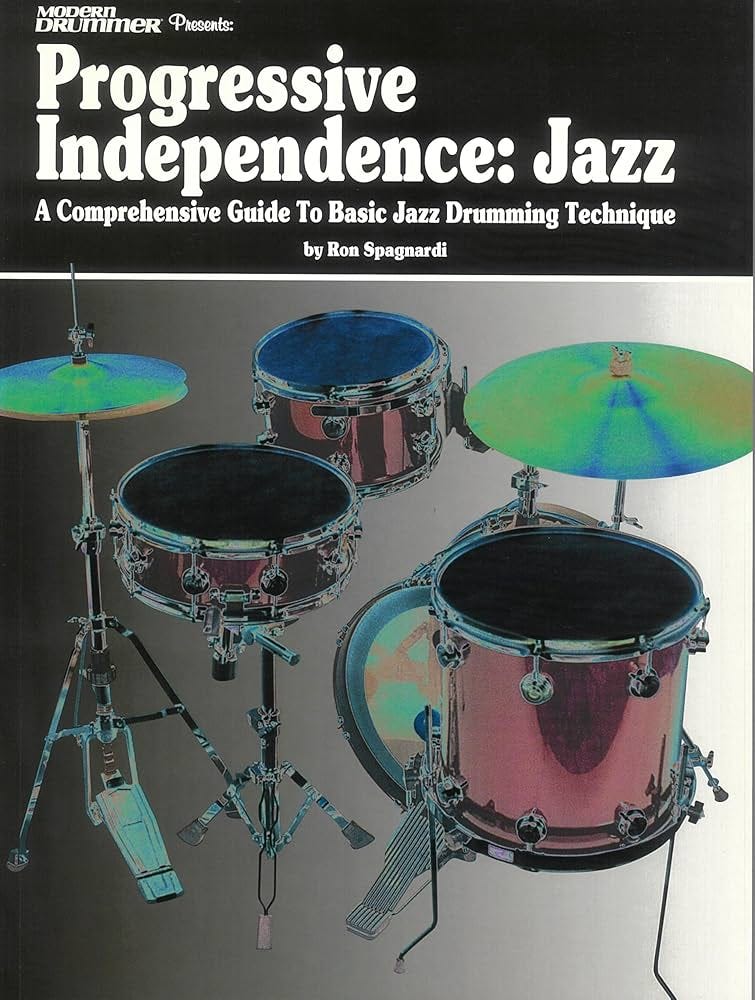
Like Stick Control, I was assigned Progressive Independence by my college drum teacher Tom Hipskind. When I first started taking lessons with Tom he asked me what kind of drummer I wanted to be. I gave a noncommittal answer that I was a rock drummer but that I wanted to be able to play everything. Tom encouraged me to specialize and focus on being a great rock drummer first. Still, he clearly thought that I’d benefit from some jazz instruction, hence Progressive Independence. Ron Spagnardi’s book was not my first exposure to jazz education. My first drum teacher, Peter Davenport, who I worked with from 7th grade until I graduated high school, was a jazz guy and put me through some pages of Jim Chapin’s Advanced Techniques For the Modern Drummer (1948) along with some of his own exercises. I made some progress on the coordination but Peter was never satisfied with my touch on the ride cymbal. I couldn’t get the swing of the “spang-a-lang” to sit where it was supposed to. Part of the trouble was that I didn’t spend enough time listening to jazz. I could practice Peter’s printouts for hours, but if I only went back to my usual teenage diet of Tool, Death, and Dream Theater I was never going to close the gap between what I wanted to sound like and how I played. How could I even know what I wanted my jazz drumming to sound like without listening to jazz in the first place?
By the time I started working with Tom Hipskind I’d listened to enough jazz to play a passable facsimile of the swing, even if it still felt like I was doing an impression of what a jazz drummer is supposed to sound like. That was enough to make this book a workable challenge, but by the end of my college career I didn’t exactly feel qualified to sit in on a jam with real deal jazz guys. Luckily I was rarely called to. Instead most of my “jazz” experience since college comes from musical theater where I’m rarely asked to provide more than the layperson’s conception of jazz drumming. Still, over the years that steady requirement of the bare minimum, along with a significant increase of time spent catching up on the jazz canon, gradually molded my jazz playing into something approaching legitimacy. With that newfound aptitude, I re-opened Progressive Independence with an equally open mind.
Progressive Independence: Jazz is organized into four sections, the first three of which contain four parts. Each part contains a number of one-bar exercises and then a handful of “summary exercises” that recombine the vocabulary from the one-bar drills into 24-bar sight reading etudes. The fourth and final section contains six etudes that draw from every previous section and part of the book, essentially serving as the final exam for all of the material preceding it. In every exercise, whether of the one-bar or 24 bar variety, you are asked to play the “spang-a-lang” on the ride cymbal, presumably with your strong hand, while you play beats two and four on the hi-hat with your foot. Against this steady ostinato you are asked to read and play various phrases with one or two of your limbs. In the first section you read with the snare drum. The second focuses on the kick drum. The third section combines both for melodic phrases that bounce back and forth between kick and snare. True to the book’s title, each part presents increasingly complicated patterns to work through, progressing part by part from quarter notes to eight notes and eventually triplets.
Despite the orderly layout there are a few interesting wrinkles to the book’s progression, some which are to its benefit, others to its reader’s frustration. Spagnardi makes the sneaky brilliant choice of asking the reader to play steady quarter notes on the kick drum during the snare reading section, which helps prime the reader for the foot-centric second section. The third part of each section presents the reader with exercises that sound identical to exercises in the first two parts but are written differently. For the drummer with limited practice time this might feel like filler padding out the book’s length, but these exercises do have the practical benefit of preparing you for the variety of drum notation conventions that you’ll encounter as a professional sight-reader. Sometimes however the order of exercises does not progress in difficulty so much as lurch forward. The single most challenging stretch of the book comes in Section 2 Part 4, when Spagnardi forces you to play steady triplets on the kick drum. Unless you play this part a good deal slower than the rest of the book, or you’ve got a background in grindcore, these pages will take longer than any other chapter to complete. By comparison the two limb reading is a walk in the park.
But is any of the material actually useful when it comes to playing jazz for real? My annoying short answer is “maybe”. Following the book’s instruction to completion will give you three tools that will absolutely help if you want to be a serious jazz drummer. First, the exercises will help you develop the dexterity and limb independence to play just about any pattern you could think of against the ‘spang-a-lang', an invaluable asset when it comes to playing jazz in live situations. Second, it’ll strengthen your sight reading skills which will help whether you’re faced with a lead sheet or working on transcriptions on your own. Finally, the exercises work as a starter kit for developing licks and vocabulary that you can use in live situations. There are some limits to the book’s vocabulary however. First, not all jazz is played with a steady spang-a-lang, especially these days. A comprehensive study in jazz independence would also force you play these patterns against variations of the ride pattern. Second, not all jazz is in 4/4. Playing in 3/4 or 5/4 would necessitate a wider range of exercises and concepts tailor-made to the rhythms of those time signatures. Finally, the emphasis on one-bar patterns limits the creative application of these concepts to safe and “square” playing. The longer summary exercises help mitigate this boxed-in quality, but even a section of two-bar phrases would go a long way to stimulate the reader’s creative imagination.
There are a number of other soft skills that this book doesn’t even try to impart on the reader. This book cannot teach you how to keep track of a song form, or how best to support a soloist, or, most crucially, how to use this vocabulary in improvisational settings. And, going back to the start here, it cannot correct your feel on the kit, though the introduction does offer a few useful pointers in that regard. Progressive Independence: Jazz is great for learning the “how” of jazz drumming but cannot teach the “when” or “why”. For that, you have to touch jazz grass1. You have to immerse yourself in the culture, study the great records and run the risk of embarrassing yourself by playing with more experienced musicians. The tools are only as useful as your taste in their application, and only you can develop your taste.
# # # # # The Promo Zone # # # # #
If you’ve enjoyed this letter, consider subscribing to Lamniformes Cuneiform for either $5 a month or the discounted price of $40 a year. I love teaching drums for a living, but it is not exactly the most lucrative profession. Every bit of support offered by my paying subscribers helps, both monetarily and emotionally insofar as I experience far more gratitude on a daily basis. I think I’ve hit a good rhythm with my paywalled posts lately, and over the last five years I’ve built a robust back catalog too. Wow, has it really been five years now? Maybe I should, uh, celebrate that somehow…
~ ~ ~ ~ ~ Listening Diary ~ ~ ~ ~ ~
Listen to this year’s running diary on Apple Music.
“Immolation” by Messa (The Spin, 2025)
According to Brad Sanders’ excellent profile of Messa for Stereogum the goal for The Spin was to emulate the sound and style of the 1980s, not just the heavy metal of that era but the whole of it. This song is the most concise representation of that mission statement. What starts as an AM radio-ready electric piano ballad erupts into heavy metal fury in the second half. I love the way the guitar restates the chorus vocal melody. Not sure how they got the lead to sound so much like a sax, but what a great effect!
“Myths Come True” by Mount Eerie (Night Palace, 2024)
Who among the musicians reading hasn’t considered Odysseus returning to Ithaca near the end of a long tour? One of Phil Elverum’s great talents as a songwriter is balancing grand, mythological themes with extremely mundane down-to-earth details. Also, despite having the rep of being a “home recordist” the guy has an excellent ear for sound design. One of the best artists of the 21st century, I’m starting to think…
“Pansa Pansa” by Fela Kuti (Underground System, 1992)
Most of my experience with Fela Kuti is with the 70s portion of his discography, and even then I’ve barely scratched the surface, so it’s interesting to hear this late period recording. Totally different production style, but same old Fela, defiant as ever.
“Book of Life” by Hugh Mundell (Africa Must Be Free By 1983, 1978)
Whatever quibbles and complaints they may have about Pitchfork the other six days of the week, anyone who ignores their recurring Sunday reviews is doing a major disservice to their record collection. Maybe I would have stumbled across this record on my own, the album title would certainly have grabbed my attention in any context, but I appreciate the critical push. Trying to get into more reggae these days, feels like a professional necessity as a drummer.
“Una Mujer Como Tu” by Larry Harlow (Salsa Sin Miseria, 1974)
It’s funny, my pathway into salsa appreciation was an inversion of the way most people learn to love a new genre. First it was the wilder, formally challenging stuff that drew me in. Now as I spend more time with the genre, I’m developing a taste for the more approachable, poppy side of the style. Very catchy chorus on this one! Been singing it to the cat all afternoon, even though he’s a boy.
No, not in *that* sense, though, uh, it probably wouldn’t hurt!