
Conversing With "Conversations In Clave" by Horacio Hernandez
Plus, four more Bellows tunes!

When I first started teaching drums as my regular profession in 2024 I selected three drum instructional books to add to my practice routine in order to stay sharp and absorb as much educational know-how as I could. First I selected the classic Stick Control. I’ve since completed Stick Control twice, once while keeping time in my left foot and once playing the hand exercises over a samba foot pattern. Now I’m currently working on what I’ve been mentally referring to as “Quantum Stick Control”, which maybe I’ll explain at a later date. The second book I picked out was Progressive Independence: Jazz. That one took a little longer, but I finished it last summer. I replaced Progressive Independence with Chris Pennie’s Polyrhythmic Potential. I finished most of that one too. The third book, which I’ve only just recently put down with plenty of meat left on the bone was Horacio Hernandez’s Conversations in Clave. It was worth the long weeks of work to finish. If you want the quick takeaway, here it is: Conversations in Clave is the most challenging and most rewarding drum book I have ever subjected myself to.
This wasn’t my first encounter with Hernandez’s work. My high school drum teacher had passed along a few printouts from Conversations when I met up with him for lessons while I was back home from college on summer break. Each of these stop gap seasons functioned as a crash course in styles or skills that we hadn’t focused on while working on my fundamentals. I struggled with our intensive on jazz, but, surprising both of us, I took to the Clave excerpts like a tropical bird to tropical waters. My experience with Latin music hardly extended beyond accidental exposure. I loved The Mars Volta and Martin Lopez’s playing in Opeth. Sure, I’d heard a lifetime’s worth of the dembow by living in New York City in 2006. And, yes Bueno Vista Social Club had dominated my parents’ stereos for a few years there. But these exposures to Latin rhythms were a candle in the sun compared to my hyper-fixation on rock and metal. I had no idea how the exercises in Hernandez’s book were supposed to be applied, but I loved the way it felt to play them. They scratched the same multi-tasking itch as the wacked out polyrhythms favored by my favorite progressive rock bands, but all while playing in a danceable 4/4.
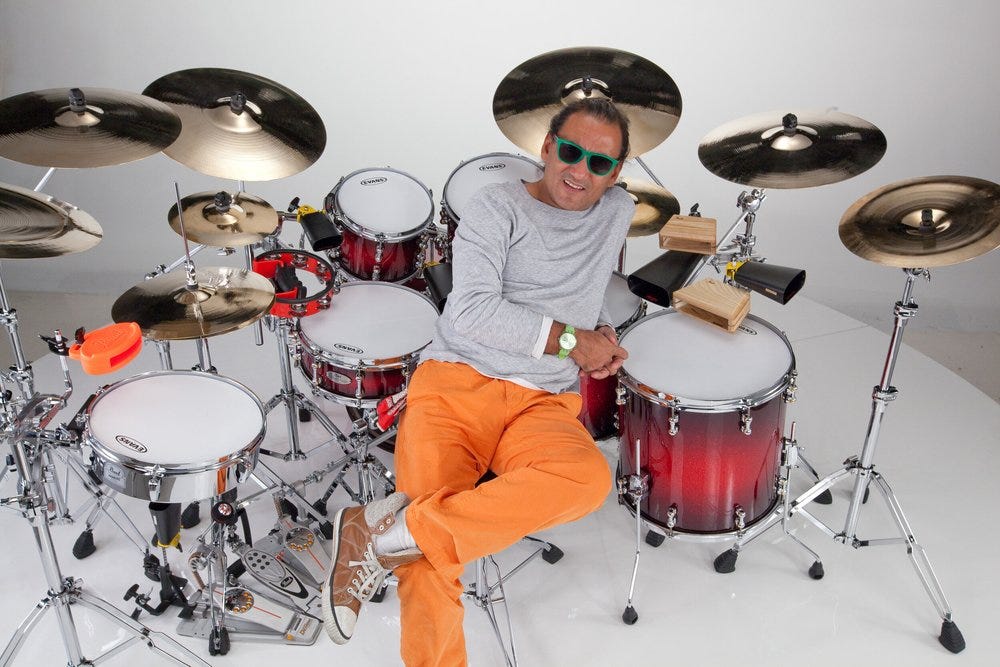
Besides, the results spoke for themselves. Hernandez was at the time a staple of the Modern Drummer Festival and thus the early days of the drumming internet. His signature trick is his ability to play a clave pattern with his left foot while improvising freely with his other three limbs. To put it in layman’s terms, if rock drumming is like rubbing your belly while patting your head, Hernandez was doing that combo while playing Dance Dance Revolution with his feet. This freakish dexterity allows Hernandez to act as a one man percussion ensemble, playing cowbell with one foot, a jam block with one hand, and melodic patterns between the kick drum and the rest of his kit. Watching the festival clips as a student my jaw was too awed to drop. I was of course fluent in the vocabulary of the great rock and metal drummers. Even the gospel chops guys were legible to me, though they blew my mind with their power and speed. Hernandez however was crushing it in ways utterly incomprehensible to me. It was as if he were operating from an entirely different rhythmic ontology, which I suppose he was. Hernandez is not simply a technical showoff either. The guy’s resume is as legit as it gets. He’s played with jazz greats, salsa legends, heck he played on Supernatural, the Santana album with god damn “Smooth” on it. He knows how to make this supernatural skillset work in high pressure, high taste situations. If you’re ever looking for a good time, type “Horacio Hernandez full concert” into YouTube and let the algo take the wheel.
Conversations In Clave is essentially a how-to guide to attaining this four limb dexterity. Hernandez first gets you used to playing the clave in one hand and working through systems of notes in the other to build your independence. Then he introduces the cascara rhythm and asks you to play that and the clave simultaneously while under going the same rigorous matrix with a third limb. Repeat the same process with other patterns that line up with the rumba clave like the mambo or the 6/8 bembe and you have a rough outline of the book. However you’ll get the idea long before you’re able to execute it. Once you get through the dry independence drills things start getting exponentially difficult. Next thing you know you’re playing through what amounts to Stick Control between two limbs while playing a clave+cascara combo in the other two. I was lucky if I could make it through one exercise a week once I got to this stretch, but even that training couldn’t help much once I got to the final two sections of the book. The penultimate section is essentially an open world invitation to mix and match between all of the material you worked through in the proceeding chapters with seemingly limitless combinations. The final section asks you to learn Hernandez’s own drum parts, and brother, they are DIFFICULT. By the end I settled for getting the gist and moving on for the sake of education. Were I to truly attempt to master the material here you likely wouldn’t see another newsletter for a year or two.
I did not need to master the book for it to have a radical effect on me. I don’t just mean in my playing either. Conversations changed the way that I heard Latin music1. The more I practiced the rumba clave the easier it was to hear it implied in the pulse of my favorite salsa records. Suddenly I was able to pick out the cascara out of a crowd of intersecting patterns. Enter the feedback effect. The easier it was to hear these patterns in context, the more I understood how to play the rhythms and what to play around them with other people. When I was confidant enough to bust out these ideas in Ferrn practice I didn’t suddenly become Juan Corea, but I did play a whole lot of stuff that I never would have thought to try before.
Conversations effect on my own playing aside, I can only stand in awe of it’s pedological perfection. Like my all time favorite drum book, Gary Chester’s The New Breed, Conversations offers the reader a clear path to 100% completion without making any apologies for how long that path might take. No steps are skipped, but you can bow out and return at any point. Long before you reach the mountain top you’ll start dreaming up your own way to apply the methods, which might send you off to a different mountain range entirely. The book is merciless, methodical, and thorough. Even tapping out halfway through will make you a significantly better player than you were before you cracked the spine.
Finally, I want to highlight the particular psychological effect of playing figures against the clave. Because the rumba clave is a two bar phrase, three notes on one side and two on the other, you get to hear the exercise in question against two different counter rhythms. Playing these figures against the clave felt like rotating an object so as to view it from another angle. The figure hadn’t changed, but its context made it sound different. What has actually changed, beyond the player’s perspective? This led to a contemplative state of mind that made even the most challenging exercises more than little soothing. I’ll have more occasion to talk about this concept of “rotating” a rhythm in the next Drumming Upstream. Until then, grab yourself a copy of Conversations In Clave and hit the woodshed. You can thank me later.
# # # # # The Promo Zone # # # # #
ICYMI: Last week I released my debut video essay, an adaptation of my newsletter series on PROGMATISM made in collaboration with my good buddy Zack Berinstein. The response has blown away our expectations, both in terms of sheer views (nearly 4,000 at the time of writing) and in the thoughtful engagement from the comment section. It has warmed my heart to see so many music fans expressing support for the tenets of a goofy philosophy I spent way too much time making up. I’ve also enjoyed the thoughtful objections from other viewers which have forced me to shore up and elaborate on my original arguments. We’ll get into the content of those objections and my response in the near future, maybe in another video…. For now, you can watch “Let’s Talk About Progmatism” on my YouTube Channel.
Bellows released another batch of four songs from our upcoming record “Que Bello!”, a double album of exquisite indie rock tunes out on June 12th via Bloody Knuckles. These four songs feature much more of my drumming than the last batch, including my best Max Weinberg impression on “Give Me All Your Love” and a rare moment when Oliver let me go buck wild on the high energy “Bureaucratic Tower”. You can watch the video for the later below, and check out Bellow’s upcoming tour itinerary here.
~ ~ ~ ~ ~ Listening Diary ~ ~ ~ ~ ~
Listen to this year’s diary on Apple Music.
“Black Swan” by Megadeth (Th1rt3en, 2011)
The ultimate irony of Megadeth’s career is that Dave Mustaine’s voice is the part of the band most likely to drive away potential fans (not to mention the stuff he uses that voice to say), but at the same time the best Megadeth songs reach that status because of his ear for melody. No one seems to like this late period record much, but I dare you to NOT hum “just like a church yard shadow” in the shower tomorrow morning after pressing play. The man has unbeatable anti-charisma.
“Die Dead Enough” by Megadeth (The System Has Failed, 2004)
I would include the official music video for this song in adherence to The Lamniformes Guide to Style and Substance, but the audio is dogshit. Here’s a static image instead. No conversation about maliciously sticky Megadeth hooks can proceed without paying due homage to “Die Dead Enough”. This chorus is psychic warfare (complimentary) and Mustaine deserves credit for not cramming in another repetition at the end of the song, choosing instead to ride out the breakdown. I’m sorry but if you’re too cool for this you aren’t the kind of metalhead I want to hang out with. They got god damn Vinnie Colaiuta doing double bass runs on this tune!
“She-Wolf” by Megadeth (Cryptic Writings, 1997)
Yet again, I sit through the verse of a Megadeth song asking “where you going with this buddy?” only to grin like a big idiot the minute the chorus kicks in. Nick Menza hit the ride cymbal harder than anyone alive in the 90s. Mustaine and Friedman stack some righteous thirds and then it’s over in a snap. I’ve said it before, but none of the 80s metal dudes weathered the 90s better than Mustaine. Anyone ever mash this up with the Shakira song of the same name?
“Make Me Forget You” by Converge (Love Is Not Enough, 2026)
The transition from the d-beat tresillo into 6/8 is exactly the kind of thing you’d hope the band that wrote “The Saddest Day” would age into. I’m grateful that this is the closest Converge got to writing a melodic song on Love. After spending my 20s pining for a slow and dynamic Converge record and then having my wish granted by the earth’s biggest monkey paw, all I need in my 30s is for Converge to go as fast and hard as they remain able to go.
“Trabajo del Tiempo” by Renatto Olivares (Aguas raras, 2026)
Solo joint from the singer of Hesse Kassel. It makes me very excited to hear the fiddly prog stuff is also what Renatto Olivares wants to get up to on his own time. Olivares strikes me as a natural comrade to artists like betcover!! and Geordie Greep across both the Pacific and Atlantic in the fight to make crooning over jazz rock the next wave. As a baritone stuck here in the States I can only salute this cosmopolitan gang from afar. Holy cow does this thing take off in the final stretch.
\ \ \ \ \ Micro Reviews / / / / /
Here are five micro reviews of albums from my vast Rate Your Music catalog. Long time Lamniformes Instagram followers will recognize these from my stories, however they’ve been re-edited and spruced up with links.

Selling England By The Pound by Genesis (1973) - Progressive Rock
*goes to the UK once* This is the greatest album ever made. An exaggeration, but not by much. I’ve long considered Genesis to be pretty neat but not a canonical favorite, but since visiting Scotland I’ve been OBSESSED with this record. I can’t speak to how well this album addresses the subject of English identity, but ask me about the music itself and I’ll talk your ears off. Every member of the band is playing out of their mind, but all that skill is devoted to a soft, burbling, melodic style heavy on ear candy and counterpoint. More importantly, each of these killer players knows when to make room for the other, and when they should all get out of the way and let Peter Gabriel cook. Gabriel is the band’s not so secret sauce, the rare prog singer whose lyrics actually improve the music. Seriously, it isn’t an exaggeration to say he’s on some T.S. Eliot shit at times. The short tunes are both gorgeous pop tunes, and the four big boys are works of staggering genius each with a distinct personality and fascinating bag of tricks. It all culminates in maybe the most effective bookend reprise in prog rock history. Absolute masterpiece that I am forcing myself to write about so that it doesn’t stay in my queue forever.

Rated R by Queens of the Stone Age (2000) - Rock
The pepperoni pizza of Queens of the Stone Age albums. It is the first call you make when you know the boys are coming over. The debut was mostly a solitary affair. Rated R is a party. With the band fleshed out behind him, Homme takes a big step forward as a singer and songwriter. The riffs are still sick, but the melodies take center stage on these tunes. His concerns remain bone simple, devoted to the reliable trinity of sex, drugs, and rock’n’roll. Rated R sports another kind of trio behind the mic, pairing Homme’s droll croon (vicodin) with Mark Lanegan’s leathery rasp (nicotine) and Nick Oliveri’s wild man routine (co-co-co-co-co-co-coaine!!!!!) on lead vocals, along with the whole rest of the cocktail on back-ups. Apparently Rob Halford’s on this thing? Hard to shake the sense that the real fun is happening in whatever room you’re not in at this function, but what you do catch is still a blast. The arranging & mixing on “Better Living…” shows a real genius for sleight of hand and “In The Fade” might be the band’s single best song. Cool 15/8 riff on the closer too. Give the delivery boy a tip. Great rock record.

The Odyssey by Symphony X (2002) - Progressive Metal
Ah, Symphony X: the metal band for precocious 11 year old boys that grew up to be unreasonably excited for this summer’s Christopher Nolan movie. I kid around, but I literally have a copy of Plato’s Republic in my backpack as I write this, so best believe I speak from love and experience. Symphony X and Dream Theater are functionally the Judas Priest and Iron Maiden of prog metal. One band consistently changed with the times, the other stuck with inhuman stubbornness to their blazing guns. In both cases it is difficult to say who made the better choice. To be certain Symphony X’s neoclassical chops are as sharp as ever, but six albums in they’ve lost any element of surprise. The shorter faster tunes are all a thrill, though Russell Allen is starting to rely a little too much on his gravelly low end at the expense of his crystal clear head voice. The longer, prog-centric tunes on the other hand are a little too lugubrious for me these days. The exception that proves the rule is the closing title track, which, let me be clear, is a god damn masterpiece. It helps that The Odyssey is as appropriate a subject for a touring rock band as you’ll find in classical literature, but no matter what the subject Symphony X clearly saved their best stuff for this epic. You aren’t getting anything like that “Triumphant!!! Champion of Ithacaaaaaaa!!” chorus from Matt Damon, let me tell ya.

Enemies of Reality by Nevermore (2003) - Heavy Metal
Enemies of Reality has a bad rep, mostly thanks to a mix so hideous that the band issued a remixed correction by Andy Sneap only two years later. That Sneap’s signature style was seen as an upgrade goes to show how deeply early-00s this record is. What an ugly transitional era for metal. Make no mistake, Nevermore’s music is fundamentally unpleasant even when mixed well. I cannot imagine this being any non-metal fan’s token heavy band. You have to love metal whole heartedly if you’re going to be even halfway on board here. Only then can you acknowledge that actually these tunes are pretty gnarly. Singer Warrell Dane was a little like kombucha; the first sip is sour, but once you acclimate it’s actually pretty good! Sure, his habit of harmonizing in major intervals over minor key riffs (played at a blistering pace on seven string guitars no less) is a little grating, but once you accept the band’s palette as the rules of engagement you can appreciate the songs they build out of it. I realize this all sounds pretty negative but I actually do like this record lmao, this is just music that is difficult to recommend if you’re not predisposed to already be into and aware of it.
The Roundhouse Tapes by Opeth (2007) - Progressive Metal
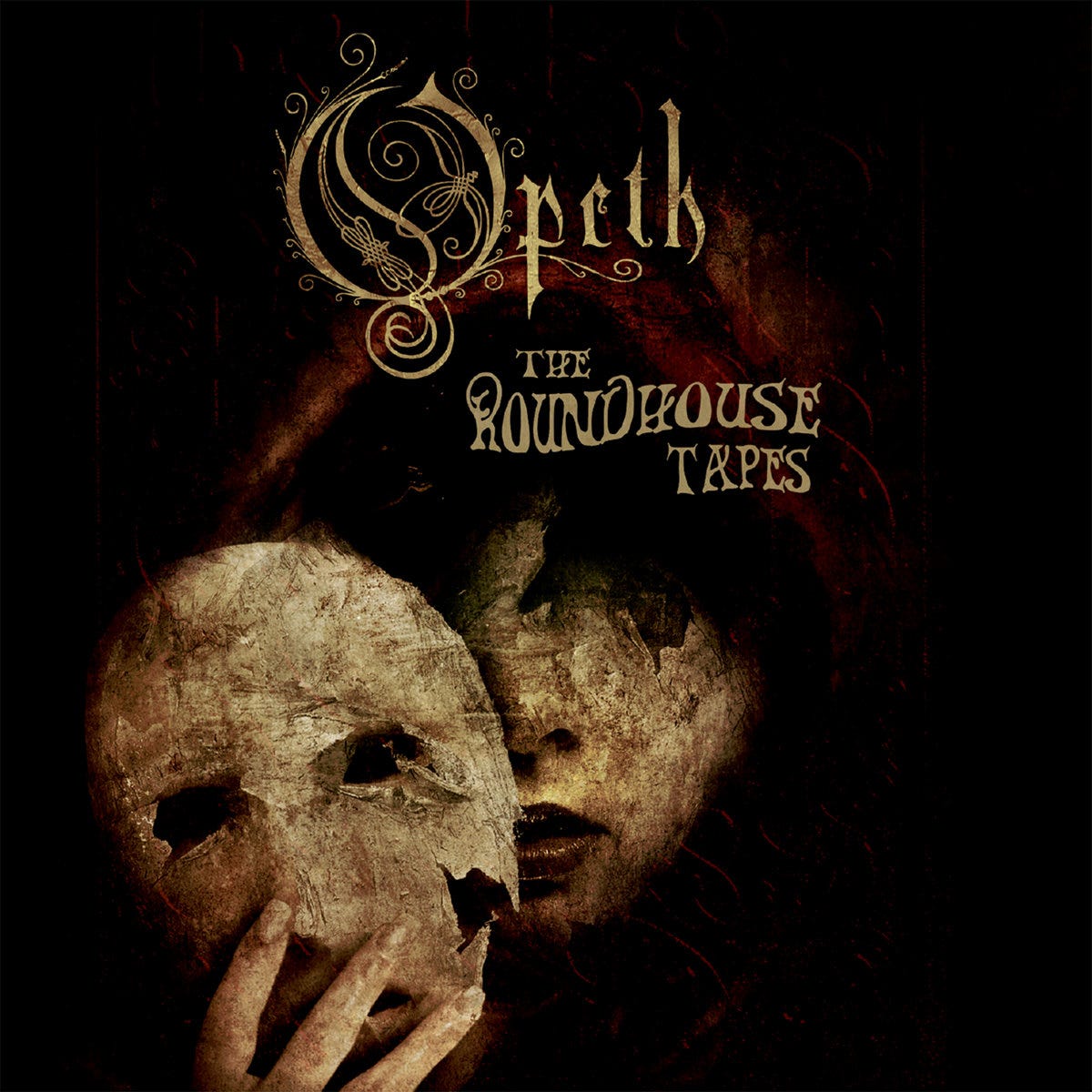
Recorded roughly around the time of their 15th anniversary, this live album captures Opeth at the peak of their metal powers, before they disassembled their sound on Watershed and re-emerged as a pure prog act. Appropriately the set list draws from the band’s entire catalog to that point. The playing is uniformly terrific and true to the records, so most of the novelty comes from hearing how the band’s new keyboardist fits into the old tunes. “Demon of the Fall” and “Face of Melinda” both reap the benefits, while not even dank mellotron can save “Under the Weeping Moon”. The biggest improvement goes to “The Night and the Silent Water”, thanks to the band doing the buildup live instead of the record’s misguided cross fading. Could do without the chatty crowd or Akerfedlt’s evasive and ironic stage banter, but if you never got to see Opeth during this era take it from me: it is as it was.
I should note that I’m using the phrase “Latin music” generally, however Hernandez’s book (and playing) mostly concerns Afro-Cuban rhythms. Central American, Brazilian, and Andean music all have their own essential rhythms and traditions that this book does not cover. Forgive my oversimplification.